Security & compliance
Security reviews, hardening, monitoring and audit groundwork for the systems you already run.
Security is where innerpulse’s founder spent much of an in-house career: web hosting, Linux and Windows infrastructure, enterprise networks and firewalls, ISO and PCI compliance, and senior security engineering at a major media company. That experience now goes into practical work for teams without a security engineer of their own: finding what is exposed, fixing what matters most, and watching for what changes.
Start with what is exposed
Most reviews work from the outside in: which hosts, ports, accounts and keys can be reached, who can log in where, and what happens if any one of them is lost. The result is a short written report with each finding ranked by risk and a fix for each, not a scanner dump.
Fixes are made with you or for you: patching and configuration, firewall and network rules, SSH and admin access, secrets moved out of code, and backups that are restored to prove they work.
Monitoring that knows what normal looks like
innerpulse builds and runs its own security monitoring, secpulse, across its Linux servers. It watches processes, file and configuration changes, logins and privilege changes from inside the kernel, keeps a tamper-evident record of every event, and sends an alert within seconds when something changes that should not. Each server’s normal behavior is learned first, so an alert means something.
The same approach works for client systems, whether through tools you already own or something lighter built for your servers.
Compliance without the theater
Years of ISO and PCI work mean knowing what an auditor will ask for, and which controls actually reduce risk. An engagement can cover scoping, policies written to match how you really work, access reviews, logging and retention, and the evidence trail, so the next audit or security questionnaire means pulling records rather than reconstructing them.
A good fit forSmall and mid-sized teams without a security engineer on staff, and anyone with an audit, a customer security questionnaire or an incident on the calendar.
In productionsecpulse: security monitoring for a Linux server fleet, with real-time alerts on what changes
What you get
- A security review of your servers, cloud accounts and applications, with findings ranked by risk
- Hardening of Linux and Windows hosts, networks, firewalls and admin access
- Monitoring and alerts for logins, configuration changes and suspicious activity
- Groundwork for PCI DSS, ISO 27001 and similar audits: policies, access reviews, logs and evidence
Tools and technologies
Discuss securityIn production
Security work. Built and run in-house.
secpulse
Knows within seconds when a server changes.
innerpulse dashboard
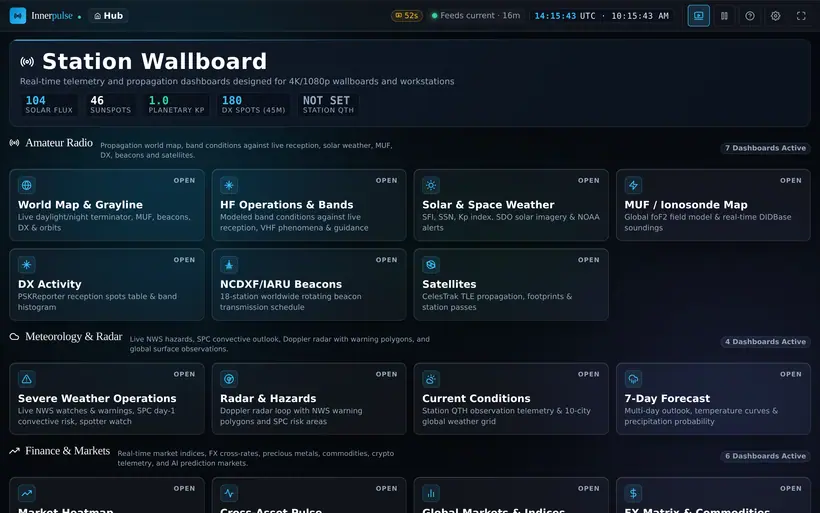
Twenty-eight live dashboards, built for a 4K wall.

games
Pull up a chair.
How engagements run
Advise, build or operate.
-
01 Deciding what to build
Advisory
A fixed-scope assessment: the workflow, the data and the risks mapped, success defined and measurable, and a written recommendation at the end.
Discuss an assessment -
02 Shipping something real
Build
The smallest version that can be tested on real inputs, with tests from day one, then hardened for production alongside your team.
Discuss a build -
03 Keeping it working
Operate
Running, measuring and improving a system once it is live, or a handover with documentation and runbooks.
Discuss operations
Is this a penetration test?
No. A review here is a hands-on look at configuration, access and exposure, with fixes made alongside it. If a contract or an audit needs a formal third-party penetration test, we can scope it, prepare for it and fix what it finds.
Can you get us through a PCI or ISO audit?
We can prepare you for one: scoping, policies, access reviews, logging and the evidence an assessor asks for. The certificate itself comes from an accredited assessor or auditor.
Do you need access to production?
Only as much as the work needs, granted and logged on your side and removed when the engagement ends. A review can start read-only.
Can you help after an incident?
Yes: containing it, working out what happened from the logs, restoring service and closing the gap that let it in.