innerpulseServicesExpertise
Software-defined radio development
Receivers, decoders and firmware for software-defined radio, from a $30 dongle to a handheld transceiver, tested against recorded signals instead of whatever is on the air.
What we build
Radio is where innerpulse started, and it is still the deepest part of the portfolio: a dozen projects across host software, desktop consoles and firmware. They share one approach. The radio is treated as a source of samples, every decoder is a pure function of those samples, and every result can be reproduced from a capture.
On the host, uSDR runs a full receiver as a Rust server and serves it to any browser over WebSocket and to a native desktop console. hfscan and digisdr do the same for HF in a terminal and headless, and scannerd follows trunked systems across several radios and transcribes what it hears. In firmware, the DM-1701 Tier III Monitor follows DMR trunking inside the radio itself.
Protocols and hardware
Decoders in the portfolio cover DMR (including Tier III trunking), P25 Phase 1, POCSAG, MDC-1200, FT8, CW, PSK, RDS, SELCAL and AX.25. Host software works with RTL-SDR and SDRplay receivers through SoapySDR, and firmware runs on STM32F405 radios with the HR-C6000 baseband and on the UV-K5 with the BK4819.
Deterministic by design
Radio software is hard to test because the signal you need is rarely on the air when you need it. So every decoder here is built to replay: a saved I/Q capture reproduces identical decode events with no radio attached, digisdr gates every build on byte-identical replays, and the P25 firmware self-tests under an emulator. A bug report becomes a capture, and a fix becomes a test that keeps passing.
Who this is for
Hardware makers who need a protocol decoded or a device taught something new, monitoring and public-safety teams who need receivers that run unattended, and radio operators and hobby projects that have outgrown a script.
In production
The proof. Running today.
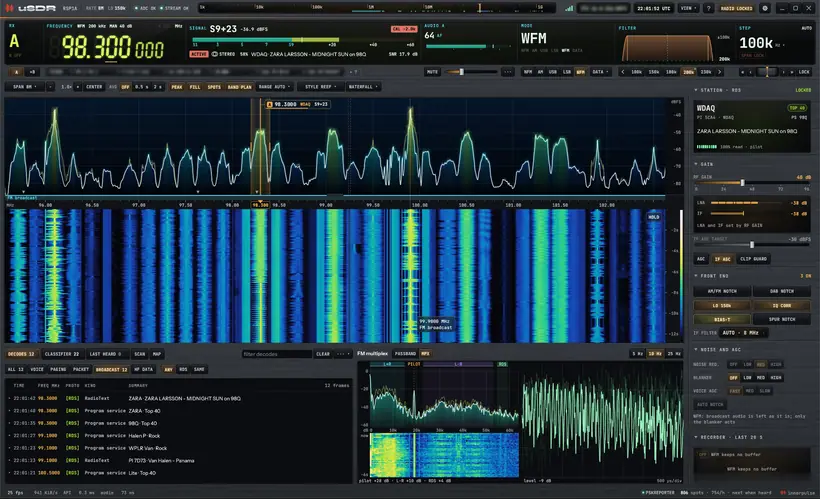
uSDR
A receiver’s front panel for a hobby SDR, as a native Rust console and a web page.
CSTM32F405HR-C6000AT1846SOpenGD77DM-1701 Tier III Monitor
A DMR Tier III trunking monitor that runs entirely inside a handheld radio.
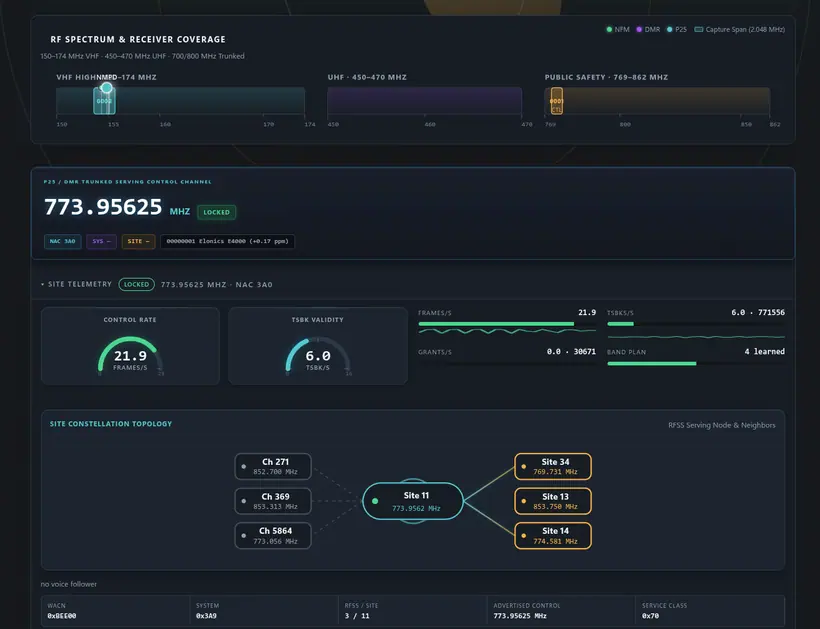
scannerd
A multi-radio trunking scanner that transcribes its own traffic.
CBK4819DP32G030MakeUV-K5 Receiver
A handheld stripped to a receiver, then taught to read pagers.
RustratatuiSoapySDRSDRplay RSP1Ahfscan
An HF panadapter and FT8, CW and PSK decoder that lives in a terminal.
C / C++STM32F405HR-C6000mbelibUnicornDM-1701 P25 Workspace
A P25 Phase 1 receive chain squeezed onto a Cortex-M4F.
Which SDR hardware do you support?
RTL-SDR and SDRplay receivers through SoapySDR on the host, and STM32-based handhelds such as the Baofeng DM-1701 and the UV-K5 in firmware. Other hardware with a documented sample interface is usually straightforward to add.
Can a receiver run in the browser?
Yes. uSDR keeps the radio and the DSP on a server and streams the spectrum, audio and decodes to any browser over WebSocket, so a receiver can be used from a phone or a laptop anywhere on the network.
Is the code open source?
Some of it. uSDR is public on GitHub; firmware forks and client work stay private unless you choose otherwise.
Next step
Have something to build? Start with a conversation.
Tell us what you are working on. The first conversation is about the problem, not a sales deck.